Perfume and fragrance photography, made with AI
Fragrance is the hardest brief in beauty, for one obvious reason and one that catches people out. The obvious one: the product is invisible. The other: the bottle is a mirror. I should say up front that I do not shoot fragrance. I build the imagery with AI and art-direct every frame by hand. But neither problem goes away when you take the camera out of it, because a rendered bottle is just as capable of looking like a flat grey shape. Here is how the category answers both, and how I answer them.
The bottle is a mirror
Glass has almost no appearance of its own. It only reads as glass when something is reflecting in it, which is why a bottle set against nothing looks like dead plastic. In a studio you solve that with a long soft source down one edge and a dark card on the other: one to draw the bottle's shape, one to give the glass an edge to hold.
I am not placing lights. What I am deciding is what the bottle is standing in, what surrounds it, and therefore what it has to reflect. Then I judge the result the way a photographer would. Is there an edge. Is the highlight doing something or just sitting there. Does the glass have weight. The physics being imitated are the same, the controls are not, and the failure looks identical either way, so it gets caught the same way: by looking hard and going again.
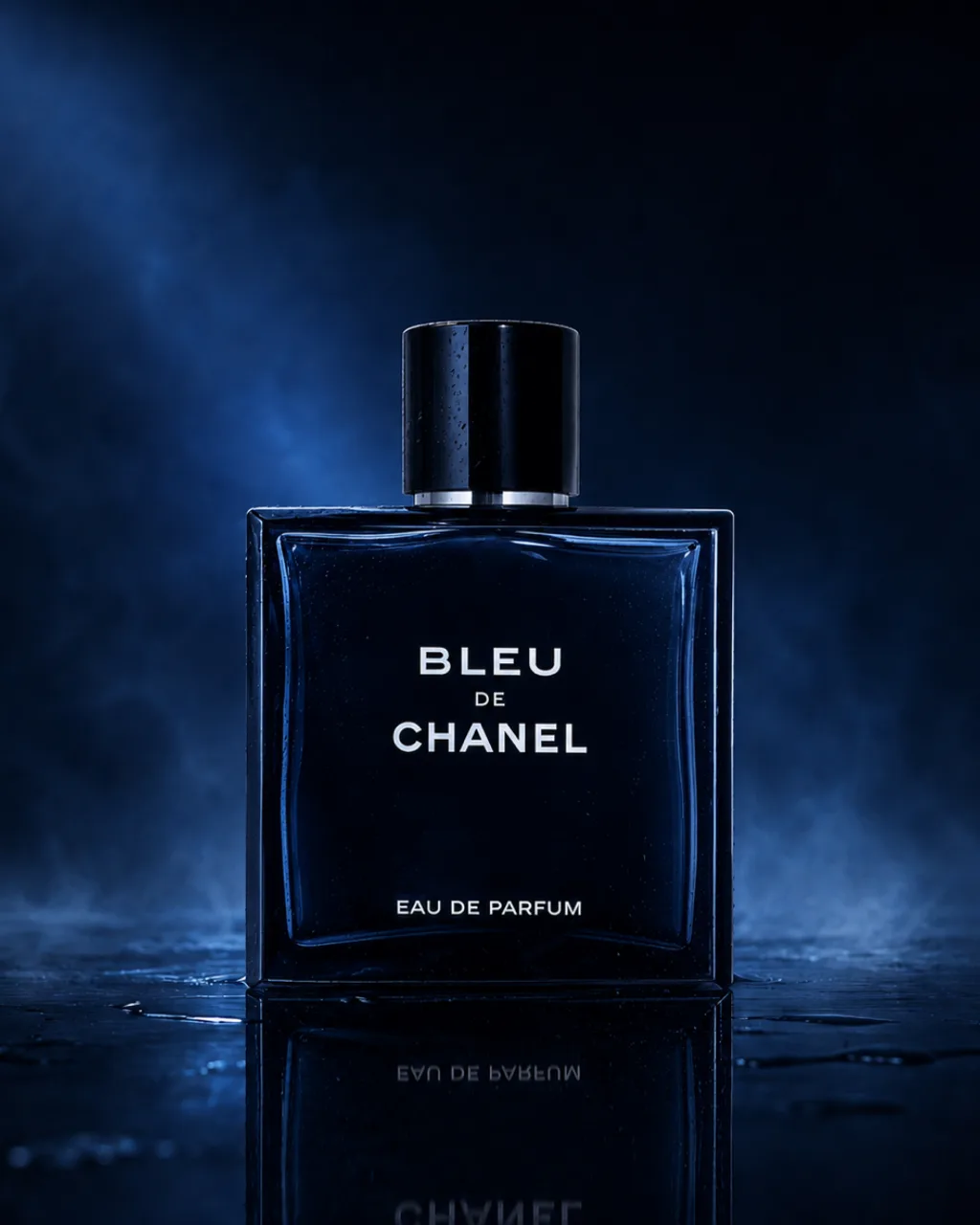
Coloured glass is harder still. Amber, deep blue and smoked grey all shift depending on what sits behind them, so the background is doing as much work as anything in front of it. The Bleu de Chanel concept set is that problem in four frames: one dark bottle, one man in navy, and everything it reflects.
You cannot show a smell, so show its consequence
The central problem of fragrance advertising is that the thing being sold cannot be seen. Every campaign in the category is an answer to that, and the answers fall into a few groups.
Material. Show what the notes are made of. Vetiver root, wet stone, split citrus, resin. This is the most honest route and it gives you texture to work with.
Atmosphere. Sell the temperature rather than the smell. Cold light and mist reads sharp and clean. Warm low light and deep shadow reads heavy and resinous. People translate this instinctively.
Gesture. A wrist, a neck, the moment after spraying. Human and immediate, and it puts scale on the bottle.
Place. Build the world the fragrance belongs to and let the bottle sit in it.
Most launches need two of the four, not all of them. Picking which two is the actual creative decision, and it should follow the fragrance rather than the trend.
The four images a fragrance launch usually needs
The pack shot. Bottle and carton, clean, accurate, retail-ready. Unglamorous and non-negotiable, because retail partners specify it tightly.
The hero. The bottle in its world, built to sell. This is the one that runs everywhere and has to hold up at any size.
The note still life. The materials of the fragrance, arranged. This is where a brand shows it knows what it made.
The human frame. Skin, gesture, the wearing of it. Optional for niche brands, essential for anything mass.
What this way of working is genuinely good at
Where it earns its place is the world. Building a set of wet stone and mist, or a marble ledge in one specific quality of afternoon light, is a construction job with a budget and a day attached. Here it is a direction decision, which means you can see five worlds for a fragrance instead of committing to one before anyone has seen anything. The Aesop Virēre concept was built that way: five surfaces, five hours of light, one bottle held still.
It also removes the reshoot problem. Fragrance sets are slow to build, so the image that is nearly right tends to stay nearly right, because going back costs a day. That constraint is gone. Nearly right becomes a note and a new version.
The range is wider than people expect. Given the bottle, the carton artwork and a clear look at how the glass is coloured, there is very little in a fragrance launch I cannot build, pack shots included. Legal and regulatory copy is set from your supplied artwork rather than generated, because that text has to be exact and legible and it is not something to leave to chance.
The real limit is not the tool, it is the reference. If the bottle exists only as a loose idea, with no sample, no render and no drawing, then nothing can be accurate about it, and that is a limit of logic rather than of software. Send me the product, or the closest thing to it that exists, and the rest is direction.
That is where the work is, and it is the same problem I have written about in beauty product photography, where glass and finish cause exactly the same trouble.
What to send me for a fragrance brief
The bottle and carton, or clear reference of both, including how the glass is coloured. The note pyramid, because it tells me what the fragrance is made of and therefore what can be in frame. Two or three fragrances whose imagery you admire, and one you actively dislike, which is usually more useful. And where the work is going, since a retail pack shot and an out-of-home hero are not the same picture.
Send those four things and the first version is built from them. If you are still comparing this against booking a studio, what a launch set actually costs has the numbers.